





|
|
|
|
|
There are various types of guitars that have grown throughout the ages. Of these, Cigar Box, Classical, Steel String, and ki ho 'alu (slack key guitar) are favorites.
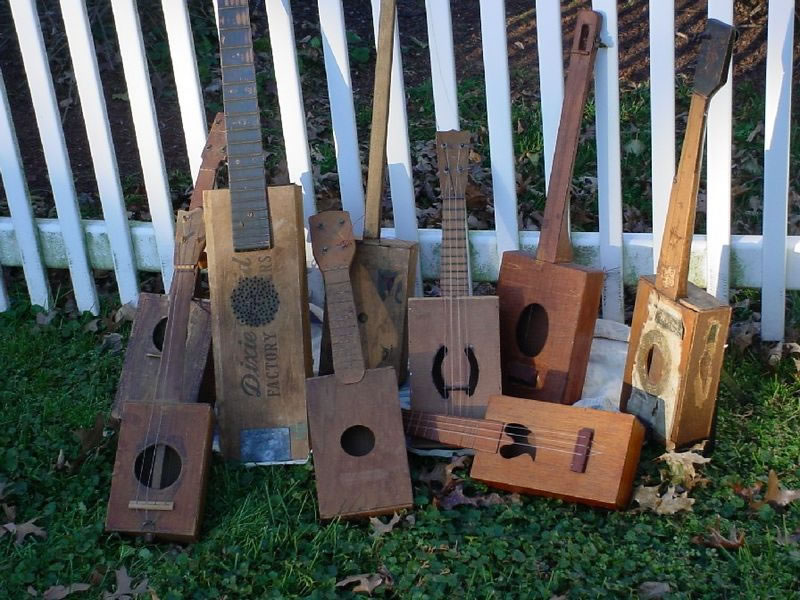 The cigar box guitar has been made famous by players who didn't have an instrument, but desired to play. Trace evidence of cigar box instruments exist from 1840 to the 1860s. The earliest illustrated proof of a cigar box instrument known is an etching of two Civil War Soldiers at a campsite with one playing a cigar box fiddle copyrighted in 1876. The etching was created by illustrator and artist Edwin Forbes who, under the banner of Frank Leslie's Illustrated Newspaper, worked for the Union Army. The cigar box guitars and fiddles were also important in the rise of jug bands and blues. As most of these performers were black Americans living in poverty, many could not afford a "real" instrument. Using these, along with the washtub bass (similar to the cigar box guitar), jugs, washboards, and harmonica, black musicians performed blues during socializations. Luthier Ted Crocker is instrumental in assisting cigar box guitar builders and players through his network Handmade Music Clubhouse. To learn more about Cigar box guitars, visit the following links: Cigar Box Guitars, Cigar Box Nation, and makezine's Cigar Box Guitar Page.
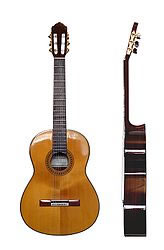 The classical guitar is characterized by:
The evolution of the classical guitar and its repertoire spans more than four centuries. It has a history that was shaped by contributions from earlier instruments, such as the renaissance period four course guitar types, the vihuela, and the baroque guitar. The popularity of the classical guitar has been sustained over the years by many great players, arrangers, and composers. A very short list might include, Gaspar Sanz (1640-1710), Fernando Sor (1778-1839), Mauro Giuliani (1781-1829), Francisco Tárrega (1852-1909), Agustín Barrios Mangoré (1888-1944), Andrés Segovia (1893-1987), Alirio Diaz (1923), Presti-Lagoya Duo (active from 1955-1967: Ida Presti, Alexandre Lagoya), Julian Bream (1933), and John Williams (1941).
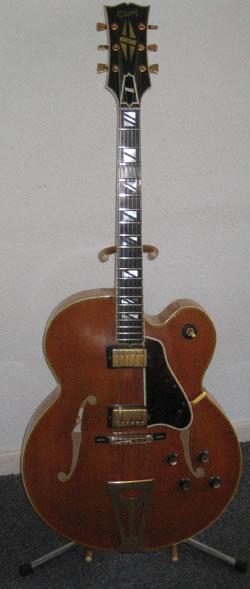 The steel string acoustic guitar is the common guitar used today by most players. A steel-string acoustic guitar is a modern form of guitar descended from the classical guitar, but strung with steel strings for a brighter, louder sound. They are often referred to simply as acoustic guitars, although strictly speaking the nylon-strung classical guitar is acoustic as well. The most common type can be called a flat-top guitar to distinguish it from the more specialized archtop guitar and other variations.
The standard tuning for an acoustic guitar is E-A-D-G-B-E (low to high), although many players, particularly fingerpickers, use alternate tunings, such as "open G" (D-G-D-G-B-D), "open D tuning" (D-A-D-F♯-A-D), or "drop D" (D-A-D-G-B-E).
There are many different variations on the construction of, and materials used in, steel-string guitars. The various combinations of the different woods and their quality, along with design and construction elements (for example, how the top is braced), are among the factors affecting the timbre or "tone" of the guitar. Many players and builders feel a well-made guitar's tone improves over time.
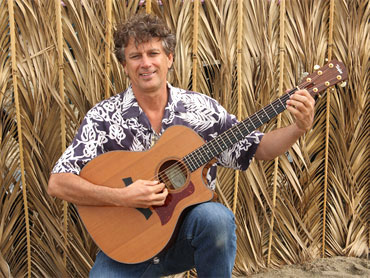 Slack-key guitar is a fingerstyle genre of guitar music that originated in Hawaiʻi. Its name refers to its characteristic tuning: the English term is a translation of the Hawaiian kī hōʻalu, which means "loosen the [tuning] key". Most slack-key tunings can be achieved by starting with a classically tuned guitar and detuning or "slacking" one or more of the strings until the six strings form a single chord, frequently G major.
In the oral-history account, the style originated from Mexican cowboys in the late 19th century. These paniolo (a Hawaiianization of españoles—"Spaniards") gave Hawaiians the guitars and taught them the rudiments of playing, and then left, allowing the Hawaiians to develop the style on their own. (Musicologists and historians suggest that the story is more complicated, but this is the version that is most often offered by Hawaiian musicians.) Slack key guitar adapted to accompany the rhythms of Hawaiian dancing and the harmonic structures of Hawaiian music. The style of Hawaiian music that was promoted as a matter of national pride under the reign of King David Kalākaua in the late 19th century combined rhythms from traditional dance meters with imported European forms (for example, military marches), and drew its melodies from chant (mele and oli), hula, Christian hymns (hīmeni), and the popular music brought in by the various peoples who came to the Islands: English-speaking North Americans, Mexicans, Portuguese, Filipinos, Puerto Ricans, Tahitians, and Samoans.
One indication of slack key's increasing visibility beyond the Islands is that when The Recording Academy instituted a GRAMMY Award for Best Hawaiian Music Album, the first four winners were slack key collections produced in Hawaiʻi: Slack Key Guitar, Volume 2 in 2005, Masters of Hawaiian Slack Key Guitar, Volume 1 in 2006, Legends of Hawaiian Slack Key Guitar—Live from Mauiand "Treasures of Hawaiian Slack Key Guitar - Live in Concert from Maui." Players from outside Hawaiʻi have also taken up the tradition, for example, Chet Atkins (who included slack key pieces on two of his albums), Yuki Yamauchi (a student of Ray Kane's and advocate of Hawaiian music in Japan), and Canadian Jim "Kimo" West (perhaps better known as guitarist with "Weird Al" Yankovic).
Links:

Brian May Guitars
www.brianmayguitars.co.uk
The Guitar Site
701 West 8th Street
Sterling, Illinois 61081
Email: Dave
Copyright 2001 - 2010
Guitar Photos copyright creative commons. Photo Jim "Kimo" West, used by permission.
Last updated on
February 23, 2010