





Tunings

Tunings abound in slack key guitar music. Each family developed their own tunings and music. Held as tightly guarded family secrets, they were heirlooms to be passed to the next generation. These are a few of the more common tunings. A fun ukulele slack key tuning is GCEG.

Tunings Table
Name Strings
Taro Patch or
G Major
DGDGBD
Raised G (G) DADGBD
G Major DGBGBD
Raised G (G) DADGBE
G Major DGDGBE
Dropped D (G) CGDGBD
D Major DADF#AD
Dropped D (G) CGDGBE
D Major DADF#DF#
Dropped G (C) CFCGCE
C Major CGEGCE
F or Bb

FBbCFAE

C Major CGCGCE
C Major CGCECE
Old Mauna Loa DGDEAD
D Wahine DADF#AC#
G Mauna Loa DGDEGD
F Wahine CFCGCE
C Mauna Loa CGEGAE
Gabby’s F Wahine FCEGCE
C Mauna Loa CGCGAE
G Wahine DGDF#BD
D Mauna Loa DGDDGD
G Wahine DGBF#BD
D Mauna Loa GDBDGD
Dropped C or C Wahine
CGDGBD
D Mauna Loa DGDGGD
Gabby’s C Wahine CGEGBE
Bb Mauna Loa FBbDFGD
C Wahine CGCGBE
Bb Mauna Loa FBbDFAD
Leonard’s C GCEGCE
Bb Mauna Loa FBbFFGD


Ki Ho'alu Header

History

Soft, magical, and sweet, ki ho’alu (slack key) guitar, was created by the people of Hawaii in the 1800’s. In ki ho’alu music, the hands enter into a beautiful and intricate dance through which the essences of the mystical islands of Hawaii are expressed. The people of Hawaii created and evolved ki ho’alu using guitars left by European sailors as well as Spanish and Mexican cowboys who taught the Hawaiians how to manage the cattle that had been introduced to the islands. In the late 1800’s, King David Kalakaua was responsible for the resurgence of support for Hawaiian cultural traditions. His sister, Liliuokalani, who became queen after his passing, was a prolific composer and excellent musician credited with over 200 compositions. Almost lost in the early 1900’s with the adoption of jazz, swing, and other modern musical forms, a number of artists emerging in the 1950’s revitalized the tradition and began teaching and inspiring others. Thanks to them and their students, ki ho’alu lives on!

What Is Slack Key?

Slack key music is filled with mana (“spiritual force”) and aloha (“divine breath, presence”). It expresses innermost feelings and honors the ‘aina (land), creatures, events, and ancestors. As you listen, you can feel it touch you and open your heart to help you feel the essence of Hawaii. Ki Ho’alu means ‘to slacken or loosen the keys’ and that’s the beginning of slack key. The strings were slackened to a tuning that sounded pleasing to the ears. Simultaneously playing a melody line and harmonies on the upper strings with the fingers and using the thumb to play a rhythm pattern on the lower strings is the foundation of slack key. Most important is playing from the heart with great aloha.

♥an alternating bass line played on the lower strings
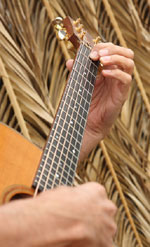
♥a melody played on the higher strings
♥a slackened key tuning
♥songs that express deep feelings and meanings
♥music that expresses the essence of places, events, and creatures
♥ (and most importantly) playing from the heart with great aloha

Traditional slack key is played very nahenahe (“soft and sweet”) either solo or with minimal accompaniment of another guitar, an ukulele, voice or other traditional Hawaiian instruments such as ‘ohe hano ihu (nose flute), ‘ili ‘ili (waterworn stones), ipu (gourd), and pakini (washtub bass).

Ki Ho'alu Player
